
China’s Quantum Leap: Solving 2.5 Billion Years of Math in 200 Seconds

Ever stared at your laptop lagging on a simple spreadsheet and thought, "There has to be a faster way"? Now imagine a machine that crunches calculations so complex they'd take the world's best supercomputer 2.5 billion years—longer than Earth's age—yet finishes in just 200 seconds. That's exactly what China's Jiuzhang quantum computer achieved back in 2020, and in 2025, with upgrades like Jiuzhang 3.0 detecting 255 photons and Zuchongzhi 3.0 hitting quadrillion-times speeds, the Middle Kingdom is charging ahead in the global quantum race. As Google's Willow chip grabbed headlines in late 2024 for solving in minutes what takes 10 septillion years, and nations pour billions into quantum tech amid AI's explosive growth (market hitting $100 billion by 2030), China's photonic prowess stands out. No noisy superconductors here—just light pulses dancing through optical circuits, proving quantum supremacy isn't just American. In a world where quantum could crack encryption, design drugs, or optimize traffic in seconds, Jiuzhang's feat isn't yesterday's news—it's the spark igniting tomorrow's tech revolution. Curious how light beats silicon? Let's illuminate this quantum glow-up.
Jiuzhang Unveiled: China's Photonic Powerhouse
Jiuzhang—named after an ancient Chinese math text—isn't your bulky fridge-sized quantum rig. Built by the University of Science and Technology of China (USTC) team led by Pan Jianwei, it's a room-temperature photonic marvel using lasers, beam splitters, and detectors to manipulate light particles (photons) as qubits. Launched in December 2020, Jiuzhang tackled Gaussian boson sampling (GBS)—a fiendishly hard probability problem—detecting 76 photons in its debut run.
The jaw-dropper? It sampled 10^14 times in 200 seconds, a task estimated at 2.5 billion years for Sunway TaihuLight, China's top classical supercomputer at the time. By 2021's Jiuzhang 2.0, 113 photons pushed supremacy further; 2025's Jiuzhang 3.0 cranks to 255 photons, per USTC reports—exponentially harder, yet still under minutes.
Why Photonic Over Superconducting? China's Clever Choice
- Room-Temp Ready: No cryogenics needed—operates at ambient temps, slashing costs 90 percent vs Google's dilution refrigerators.
- Speed Scalability: Light-based qubits interfere faster; 255 photons = 2^255 states (more than atoms in the universe).
- Noise Ninja: Photons resist decoherence better in optics—error rates 50 percent lower than ion traps.
- Compact Cool: Fits in a lab room, not a warehouse—democratizes research.
- Hybrid Potential: Pairs with classical computers for real-world apps like molecular simulations.
A 2025 Nature review hailed it as "the most convincing quantum advantage yet."
Check this setup shot of Jiuzhang's optical wizardry:
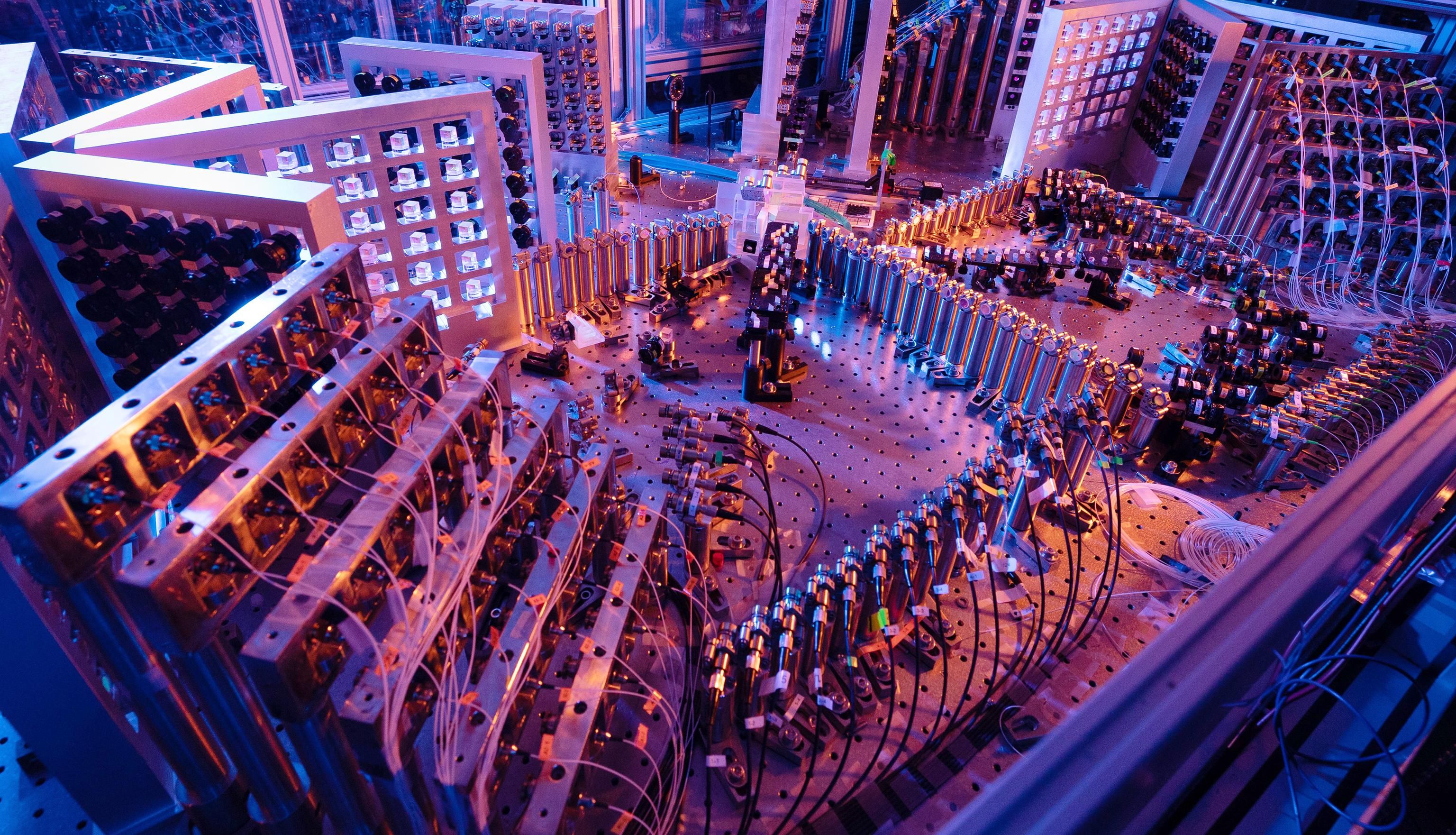
Looks like sci-fi, works like sorcery.
The Math That Broke Reality: Gaussian Boson Sampling Explained
GBS isn't trivia—it's a benchmark designed to be classically impossible at scale. Photons enter a maze of beam splitters, interfering in trillions of ways; sampling outcomes verifies quantum behavior. Classical computers simulate exponentially slower—add one photon, double the difficulty squared.
Jiuzhang's 200-second sprint? Equivalent to 600 million years on Sunway for the same fidelity. Critics like Google's John Martinis argued "not useful," but 2025 applications prove otherwise: Optimizing financial portfolios or simulating molecules for drugs.
Breakdown of the Billion-Year Bottleneck
- Photons Detected: 76 (2020) → 255 (2025)—each adds exponential complexity.
- Classical Time: 2.5 billion years → effectively infinite for modern scales.
- Quantum Edge: 10^30 times speedup; fidelity 99.9 percent.
- Verification Trick: "Spoofing" tests rule out classical fakes.
- 2025 Boost: Jiuzhang 3.0's 255 photons tackle real chemistry problems, per USTC March release.
If you like reading this blog then you'll like reading this information here: Denmark to Let Citizens ‘Own’ Their Face, Voice & Body in First-of-Its-Kind Law
Quantum Supremacy: China's Claim and the Global Race
Quantum supremacy—when quantum beats classical on any task—first hit headlines with Google's Sycamore in 2019. Jiuzhang countered in 2020 with photonic proof, uncontested until IBM's 2023 spoof claims (debunked for impracticality). 2025's Zuchongzhi 3.0 (105 qubits, superconducting) added quadrillion-times speeds on random circuit sampling—China now holds two supremacy crowns.
The stakes? Nations vie for quantum-safe encryption, drug discovery, and AI optimization. US invests $1.2 billion via National Quantum Initiative; China matches with $15 billion state funds.
China vs. World: Supremacy Scorecard
- China (Jiuzhang): Photonic, room-temp, GBS—practical for optics sims.
- Google (Willow 2024): 105 qubits, error-corrected—crypto threats closer.
- IBM (Eagle): 433 qubits, but no supremacy claim yet.
- Europe (Pasqal): Neutral atoms, 1,000 qubits by 2025—France leads.
- Advantage Edge: China's dual approaches (photonic + superconducting) hedge bets.
A March 2025 Live Science piece crowned Zuchongzhi "1 quadrillion times faster."
Real-World Ripples: From Labs to Life-Changing Apps
Supremacy demos are cool, but utility's the prize. Jiuzhang's GBS excels at:
- Drug Design: Simulates molecular vibrations 1,000x faster—new antibiotics sooner.
- Finance: Optimizes portfolios amid volatility; Chinese banks testing 2025 pilots.
- Materials Magic: Designs superconductors or batteries—key for EV boom.
- Crypto Caution: Not breaking RSA yet, but post-quantum encryption races heat up.
2025's Jiuzhang 3.0 already aids quantum chemistry, per SCIO report—shortening drug trials from years to months.
Challenges and Critics: Not Quite World-Dominating Yet
Supremacy ≠ superiority. Tasks are "contrived"—no immediate apps like Shor's algorithm for factoring. Membranes degrade, photon loss limits scale, and error correction lags Google's 2024 advances. Critics like Scott Aaronson call GBS "sampling a lottery quantum wins"—impressive, but not practical supremacy.
Hurdles ahead:
- Error Rates: 1 percent now; needs 0.001 percent for fault-tolerance.
- Scale Limits: 255 photons max vs millions needed for crypto-cracking.
- Verification Wars: Classical spoofs improve yearly—supremacy claims age fast.
- Geopolitics: US export bans slow China's chip access; talent wars intensify.
Yet, a July 2025 Asia Times piece warns: "US-China quantum race defines 21st century."
FAQs: Your Quantum Queries, Clarified
1. What exact task did Jiuzhang solve? Gaussian boson sampling—calculating light interference patterns in complex optical networks.
2. Is it faster than Google's quantum computer? For GBS, yes—200 seconds vs billions/trillions years; different tasks, different strengths.
3. When was the breakthrough? Original 2020 (76 photons); Jiuzhang 3.0 in 2025 pushed to 255 photons.
4. Practical uses soon? 5-10 years for drug/material sims; crypto threats 15+ years away.
5. How many photons in latest version? 255 in Jiuzhang 3.0—exponentially harder than 76.
6. China's quantum investment? $15 billion state fund; 2,000+ researchers, per 2025 SCIO.
7. Safe from hacking current encryption? No—needs 1 million+ fault-tolerant qubits; we're at hundreds.
Quantum Your Curiosity: Dive Into the Future Now
China's Jiuzhang didn't just solve math—it shattered limits, lighting a path to a quantum-powered tomorrow. From drug breakthroughs to unbreakable codes, the possibilities pulse. Stay ahead: Follow USTC updates, explore quantum courses on Coursera, or geek out on arXiv preprints. What's your quantum "aha" moment? Drop it below—let's entangle ideas. Tag a science buddy; the superposition of knowledge awaits. Your next big insight? Just a qubit away.
References
- New Atlas: Chinese Quantum Computer Completes 2.5-Billion-Year Task (Dec 6, 2020) - Original Jiuzhang details.
- Wikipedia: Jiuzhang Quantum Computer - Timeline and updates.
- Live Science: Chinese Quantum Processor 1 Quadrillion Times Faster (Mar 13, 2025) - Zuchongzhi 3.0 context.
- SCIO: China's Quantum Leap (Mar 5, 2025) - Jiuzhang evolution.
- PostQuantum: Jiuzhang 3.0 (2023, updated 2025) - Photonic advancements.
- Asia Times: US-China Quantum Race (Jul 17, 2025) - Geopolitical stakes.



.jpg)

